
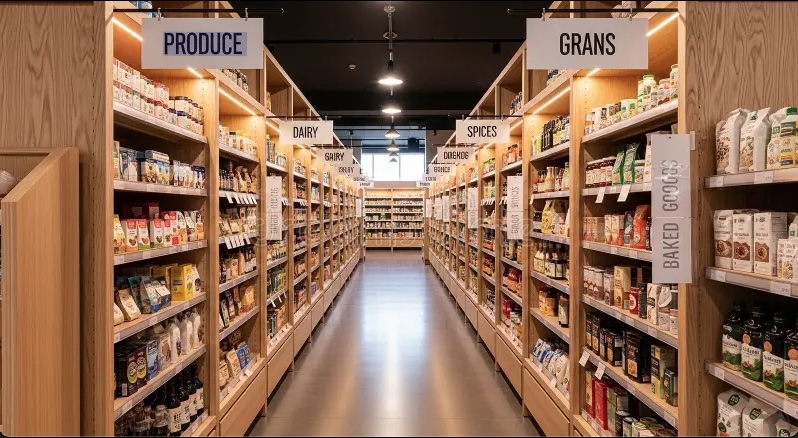
Boulder County’s grocery landscape is unlike most markets in the country. Between the natural foods co-ops along Pearl Street, the full-service supermarkets anchoring centers like the Twenty Ninth Street Mall and Table Mesa Shopping Center, and the specialty markets tucked into neighborhoods from Gunbarrel to Lafayette, local shoppers have more choices than almost anywhere in Colorado. That variety means competition is fierce, and the in-store experience matters as much as what is on the shelves. Whether you operate a large-format store off 28th Street or a neighborhood market in Longmont’s historic downtown, your signage is the first and most constant communication tool you have with customers walking through your doors. Directory signs in particular shape how efficiently people move through your space, how long they stay, and whether they leave satisfied or frustrated.
Quick Answer
Directory signs are the overhead and endcap panels that label aisles, departments, and service areas inside a grocery store. For Boulder-area grocers, well-designed directory signage reduces the single most common customer complaint, which is not being able to find products, while supporting faster restocking and a more organized store layout. Investing in clear, consistent directory signs directly improves customer satisfaction and average basket size.
Why Directory Signs Matter for Grocery Stores
Grocery stores are among the most complex retail environments any customer navigates. A typical Boulder supermarket carries between 30,000 and 50,000 SKUs across dozens of departments, from bulk goods and produce to deli counters and health and beauty. Without clear directory signage, shoppers default to one of two behaviors: they wander aimlessly, which leads to frustration and shorter visits, or they ask staff for help, which pulls employees away from stocking, checkout, and other tasks. Neither outcome is good for the store. Directory signs solve this by creating a visible, intuitive map of the store that customers absorb almost unconsciously. Overhead aisle markers, department identification panels, and directional signs near entrances all work together to reduce cognitive load. When a customer walks into your store and can immediately identify where produce ends and dairy begins, where the international foods aisle is, and where to find the pharmacy window, they feel confident. That confidence translates into longer visits, more impulse purchases, and fewer negative interactions with staff. For stores in competitive corridors like the stretch of 30th Street in Boulder or the growing retail centers in Erie, that edge matters. Studies from the retail signage industry consistently show that clear in-store navigation increases per-trip spending by eight to twelve percent. Directory signs are not decoration. They are operational infrastructure.
Best Sign Types for Grocery Store Navigation
Directory signs come in several formats, and most grocery stores benefit from using a combination rather than relying on a single type. Overhead aisle markers are the workhorse of grocery navigation. These are the double-sided panels mounted above each aisle listing the product categories found in that row. The best versions use high-contrast text, a consistent color scheme, and large enough fonts to be legible from twenty feet away. Department identification signs are larger-format panels or dimensional letters that mark major zones like Bakery, Deli, Meat and Seafood, or Floral. These are typically mounted higher on walls or suspended from the ceiling and serve as landmarks that help customers orient themselves in the store. Directional signs are smaller panels placed at decision points, such as store entrances, the ends of aisles, or near checkout lanes, pointing customers toward restrooms, customer service, or specific departments. Endcap signs identify promotional or seasonal displays and help customers understand why a product is featured outside its normal location. Finally, overhead store directories near the entrance provide a birds-eye category map of the entire store. For Boulder-area stores that emphasize local sourcing or organic products, directory signage can also incorporate branding elements that reinforce those values without cluttering the navigation function.
Local Considerations for Grocery Signs in Boulder County
Boulder County presents some specific considerations for grocery signage that stores in other markets may not face. The City of Boulder has detailed sign code regulations that govern size, illumination, and placement of exterior signs, and while interior signage is generally less regulated, any signs visible from outside the building may be subject to review. Stores in the Pearl Street or University Hill areas should verify compliance before installing large window-facing directory boards. In Longmont, newer retail developments along Main Street and in the Village at the Peaks area often have architectural guidelines from the property management company that affect signage style and mounting methods. Lafayette and Erie are experiencing rapid growth with new grocery-anchored shopping centers, and getting signage right during the initial build-out is far more cost-effective than retrofitting later. Lyons, with its smaller commercial footprint, tends to favor signage that fits the town’s mountain-community character, which means natural materials and earth tones often work better than bright plastics. Gunbarrel’s retail spaces are a mix of older strip centers and newer mixed-use developments, each with different ceiling heights and mounting options that affect what types of directory signs are practical. Across the entire Front Range, altitude and low humidity also affect material choices. Certain adhesives and vinyl products perform differently at five thousand feet than they do at sea level, and experienced local fabricators account for this in material selection.
Common Grocery Sign Mistakes to Avoid
The most frequent mistake grocery stores make with directory signage is treating it as an afterthought. Signs get installed during the initial build-out, and then nobody updates them for years even as departments move, product categories shift, and the store layout evolves. Outdated aisle markers that list products no longer stocked in that row are worse than no signs at all because they actively mislead customers. The second common mistake is poor legibility. This usually means fonts that are too small, low contrast between text and background colors, or too many items listed on a single panel. A directory sign that requires a customer to stand directly underneath it and squint is not doing its job. Grocery stores should test sign readability from at least fifteen to twenty feet away under actual store lighting conditions. Third, inconsistent design across the store creates visual noise. When the bakery department has one style of sign, the deli has another, and the aisles use a third, the overall effect is chaotic rather than helpful. A unified sign system with consistent typography, color coding, and mounting heights makes the entire store feel more organized. Finally, many stores neglect bilingual or multilingual signage in communities where it would be genuinely useful. Parts of Longmont and Lafayette have significant Spanish-speaking populations, and adding Spanish text to directory signs is a practical decision that improves the shopping experience for a meaningful portion of the customer base.
Serving Boulder County Grocery Stores and Markets
Niwot Signs works with grocery stores, natural foods markets, and specialty food retailers across Boulder County and the surrounding Front Range communities. From full-format supermarkets in Boulder and Longmont to smaller neighborhood grocers in Lafayette, Erie, Lyons, and Gunbarrel, we understand the specific challenges of grocery signage in this market. That includes familiarity with local sign codes, property management requirements at major shopping centers, and the material considerations that come with Colorado’s climate and altitude. Our work ranges from complete interior directory sign systems for new store build-outs to updating and refreshing existing aisle markers and department signs for stores undergoing remodels. We also fabricate individual replacement panels for stores that need to update specific sections without overhauling the entire system.
Planning Your Grocery Store Signage
If you are planning a new grocery store, undergoing a remodel, or simply noticing that your current directory signs are outdated or ineffective, the planning process starts with a straightforward store walk-through. The goal is to map customer flow patterns, identify decision points where people hesitate or ask for help, and evaluate the current signage for legibility, accuracy, and consistency. From there, a sign plan can address immediate needs like replacing worn or incorrect aisle markers while also considering longer-term improvements like a unified design system or department identification upgrades. Material selection, mounting methods, and compliance with any applicable local codes are all part of the conversation. Niwot Signs offers consultations for Boulder County grocery operators who want a professional assessment of their current signage. There is no obligation, and the goal is to help you understand what is working, what is not, and what options make sense for your store and budget.
Frequently Asked Questions
How often should grocery store directory signs be updated?
Directory signs should be reviewed at least once a year and updated whenever there is a significant change to store layout, department locations, or product category placement. Many stores find that aisle markers need updates every two to three years as product assortments evolve. If your signs still reference departments or categories that have moved or been eliminated, they are actively hurting the customer experience and should be replaced promptly.
Frequently Asked Questions
What materials work best for grocery store aisle signs in Colorado?
Rigid PVC, aluminum composite panels, and acrylic are the most common materials for grocery directory signs along the Front Range. These materials hold up well in the low-humidity environment typical of Boulder County and resist warping over time. For overhead aisle markers, lightweight aluminum composite is a popular choice because it keeps weight low while providing a clean, professional surface for printed or vinyl graphics. Avoid foam-core materials in any application where signs may be bumped by stocking equipment.
Frequently Asked Questions
Do interior grocery store signs require permits in Boulder?
Generally, interior signage in Boulder does not require a sign permit as long as the signs are not illuminated and are not visible from the exterior of the building. However, if your directory signs are near windows or entrance areas where they can be seen from outside, they may fall under the City of Boulder sign code. It is always worth checking with the planning department or your sign company before installation, especially in regulated commercial zones like Pearl Street or University Hill.
Frequently Asked Questions
How much do directory signs for a grocery store typically cost?
Costs vary significantly based on the size of the store, the number of aisles and departments, materials selected, and whether the project is a full system or a partial update. A complete set of overhead aisle markers for a mid-sized grocery store with twelve to sixteen aisles might range from a few thousand dollars to ten thousand or more depending on material and design complexity. Individual replacement panels are much less expensive. The best approach is to get a quote based on your specific store layout and needs rather than relying on general estimates.